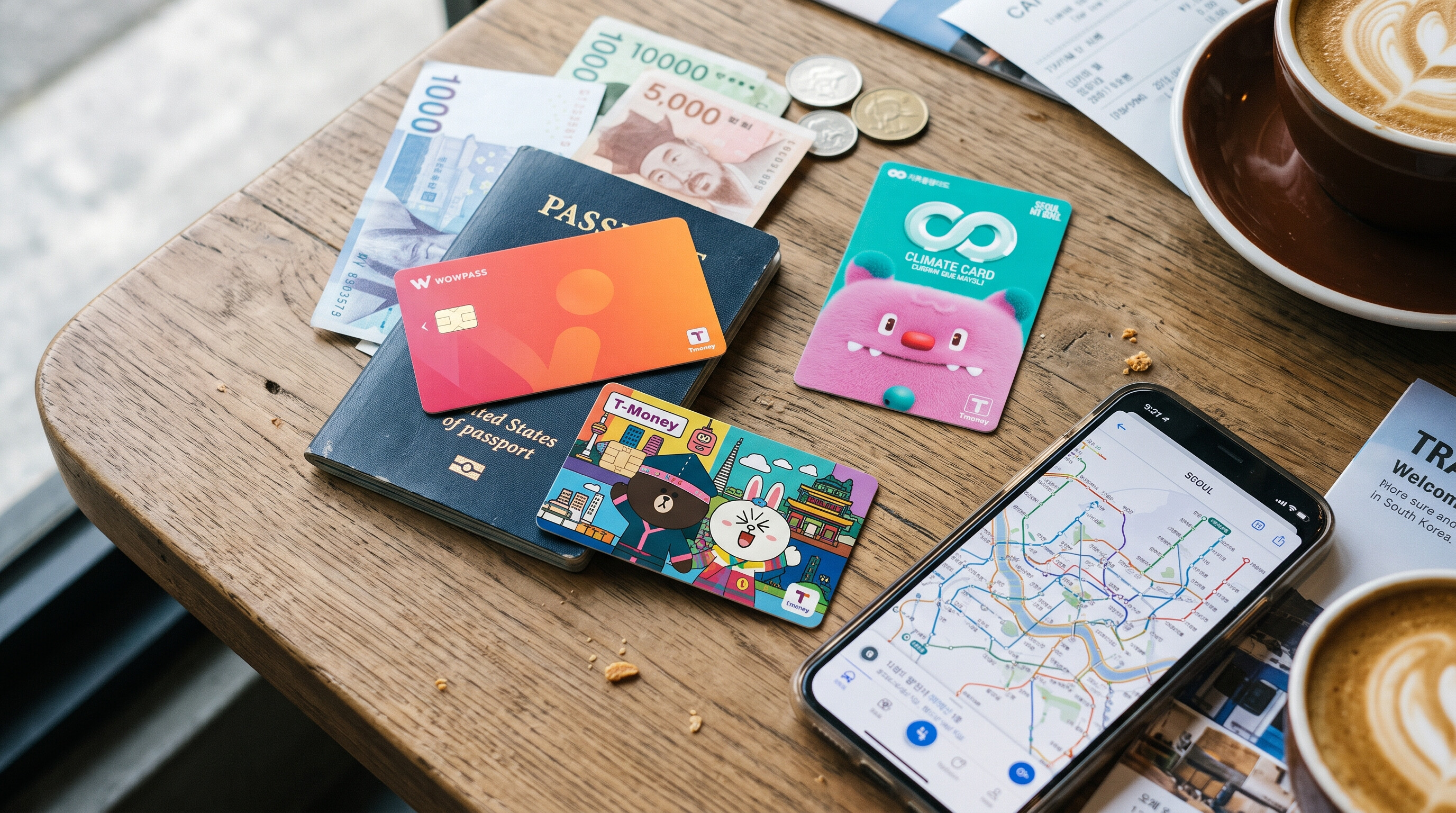
Quick Verdict (TL;DR):
Choosing the right card comes down to where you are traveling and how you prefer to pay:
- Get the Seoul Climate Card if your itinerary is focused on Seoul and you plan to take the subway or bus 3 or more times a day—it gives you 100% unlimited transit rides starting at just 5,000 KRW/day.
- Get WOWPASS if you want seamless cashless travel, zero currency exchange headaches, and a card accepted at virtually every Korean restaurant, cafe, and street shop, with a built-in T-Money chip for nationwide transit.
- Get a Traditional T-Money Card if you are traveling across multiple Korean cities (Seoul, Busan, Jeju), already carry an international no-fee credit card, and just need a simple, pay-per-ride transit pass.
- The Savvy Traveler Choice: Use the Dual-Card Combo—a Seoul Climate Card for unlimited metro rides in the capital, plus a WOWPASS for nationwide backup transit, airport transfers, and fee-free card payments.
1. The Korean Travel Card Dilemma in 2026
Planning a trip to South Korea used to be simple: you landed at Incheon International Airport, bought a cute plastic T-Money card at a convenience store, fed Korean Won banknotes into a subway machine, and tapped your way across the peninsula.
Today, international travelers face three major choices at airport arrival halls: the traditional T-Money Card, the all-in-one tourist prepaid debit card WOWPASS, and Seoul’s unlimited public transit pass, the Seoul Climate Card (기후동행카드).
Each card solves a distinct travel challenge:
- T-Money: Reliable, pay-as-you-go transit accepted nationwide.
- WOWPASS: Cashless convenience, instant foreign currency exchange at automated kiosks, and universal merchant card acceptance.
- Seoul Climate Card: Flat-rate, unlimited subway, bus, and bike rides across Seoul designed to stop transit fare anxiety.
To help you decide which one belongs in your wallet, this guide provides a detailed head-to-head breakdown of fees, transit boundaries, reload mechanics, real-world travel scenarios, and the best card combinations.
2. Side-by-Side Comparison: WOWPASS vs. Climate Card vs. T-Money
The following comparison table highlights every critical difference across the three cards:
| Feature / Criteria | Seoul Climate Card (Tourist Pass) | WOWPASS All-in-One Card | Traditional T-Money Card |
|---|---|---|---|
| Card Type | Flat-rate unlimited transit pass | Prepaid debit card + T-Money chip | Pay-as-you-go transit smartcard |
| Physical Card Cost | 3,000 KRW (~$2.20 USD) | 5,000 KRW issuance fee (~$3.70 USD) | 3,000 – 5,000 KRW (~$2.20 – $3.70 USD) |
| Fare Structure | Unlimited flat-rate (1 to 7-day passes) | Pay-per-ride transit + merchant retail | Pay-per-ride (1,550 KRW subway base) |
| Pass Duration Options | 1, 2, 3, 5, or 7 days (also 30 days) | No expiration for balance (valid 6 yrs) | No expiration on stored cash balance |
| Geographic Transit Scope | Seoul City (+ select partner suburbs & ICN exit) | Nationwide (Seoul, Busan, Jeju, etc.) | Nationwide (All major Korean cities) |
| Shinbundang Line (Gangnam–Bundang) | ❌ Strictly excluded | ✅ Supported (via T-Money chip) | ✅ Supported |
| Boarding at Incheon Airport (AREX) | ❌ Cannot tap in at ICN | ✅ Supported on all AREX lines | ✅ Supported on all AREX lines |
| Exiting at Incheon Airport (AREX) | ✅ Supported (if boarded in Seoul) | ✅ Supported | ✅ Supported |
| Retail Merchant Payments | ❌ None (transit only) | ✅ Accepted at 99.9% of card readers | ⚠️ Convenience stores & bakeries only |
| Currency Exchange Support | ❌ None (KRW only) | ✅ 16 currencies direct at kiosks | ❌ None |
| Card Reload Methods | KRW cash / credit card at subway kiosks | Foreign cash at kiosks OR credit card/Apple Pay in app | KRW cash banknotes only |
| Extra Tourist Perks | 50% off select Seoul attractions | App cashback rewards (Olive Young, Daiso) & KRW ATM withdrawal | Collectible K-pop & character designs |
| Smartphone App Features | None for foreign tourists | Real-time alerts, balance check, T-Money NFC top-up, card lock | Basic balance check via NFC |
| Best Travel Style | High-density Seoul sightseeing (3+ rides/day) | Cashless shopping, dining & multi-city travel | Minimalist transit riders & budget multi-city trips |
3. Deep Dive: Understanding Each Card
To choose the best setup for your vacation, let’s explore how each card operates in practice.
Option 1: Seoul Climate Card (기후동행카드) — The Unlimited Sightseer
The Seoul Climate Card was launched by the Seoul Metropolitan Government and expanded to include dedicated Short-Term Tourist Passes (1, 2, 3, 5, and 7-day options).
- Pricing:
- 1-Day Pass: 5,000 KRW (~$3.70 USD)
- 2-Day Pass: 8,000 KRW (~$5.90 USD)
- 3-Day Pass: 10,000 KRW (~$7.40 USD)
- 5-Day Pass: 15,000 KRW (~$11.10 USD)
- 7-Day Pass: 20,000 KRW (~$14.80 USD)
- 30-Day Pass: 62,000 KRW (or 55,000 KRW Youth Discount for travelers aged 19–39; add 3,000 KRW for Ttareungi bikes)
- How It Works: After buying the blank physical card for 3,000 KRW, you head to an automated ticket vending machine inside any Seoul subway station, choose your pass duration, and select your activation date. Once active, you can tap into subways, Seoul municipal city buses (blue, green, maeul, and night buses), and unlock Seoul’s Ttareungi public bicycles (included on 30-day bike passes) plus enjoy 50% admission discounts at Seoul Botanic Park and Seoul Science Center.
- The Break-Even Math: Because standard Seoul subway rides start at 1,550 KRW (and city buses cost 1,500 KRW), you break even on a 3-Day pass with just 2 to 3 rides per day. If you hop between Hongdae, Gyeongbokgung Palace, Seongsu-dong, and Myeongdong in a single day, the Climate Card saves you significant cash.
- The Major Limitations:
- It primarily covers Seoul municipal borders (plus select participating satellite municipalities such as Gimpo, Goyang, Gwacheon, Guri, and Namyangju on designated lines). However, if you take a day trip to Suwon Hwaseong Fortress, Everland (Yongin), Incheon Chinatown, or Nami Island (Gapyeong), or travel to Busan, the card will fail at the exit gate.
- The privately run Shinbundang Line (DX Line connecting Gangnam to Pangyo and Suwon) is strictly excluded.
- You cannot tap in at Incheon Airport to begin your trip into Seoul (though you can tap out at Incheon Airport when traveling out from central Seoul on the AREX All-Stop train).
Pro Tip: For an exhaustive station-by-station breakdown of coverage, kiosk reload steps, and turnstile rules, read our dedicated Seoul Climate Card complete guide.
Option 2: WOWPASS — The All-in-One Cashless Powerhouse
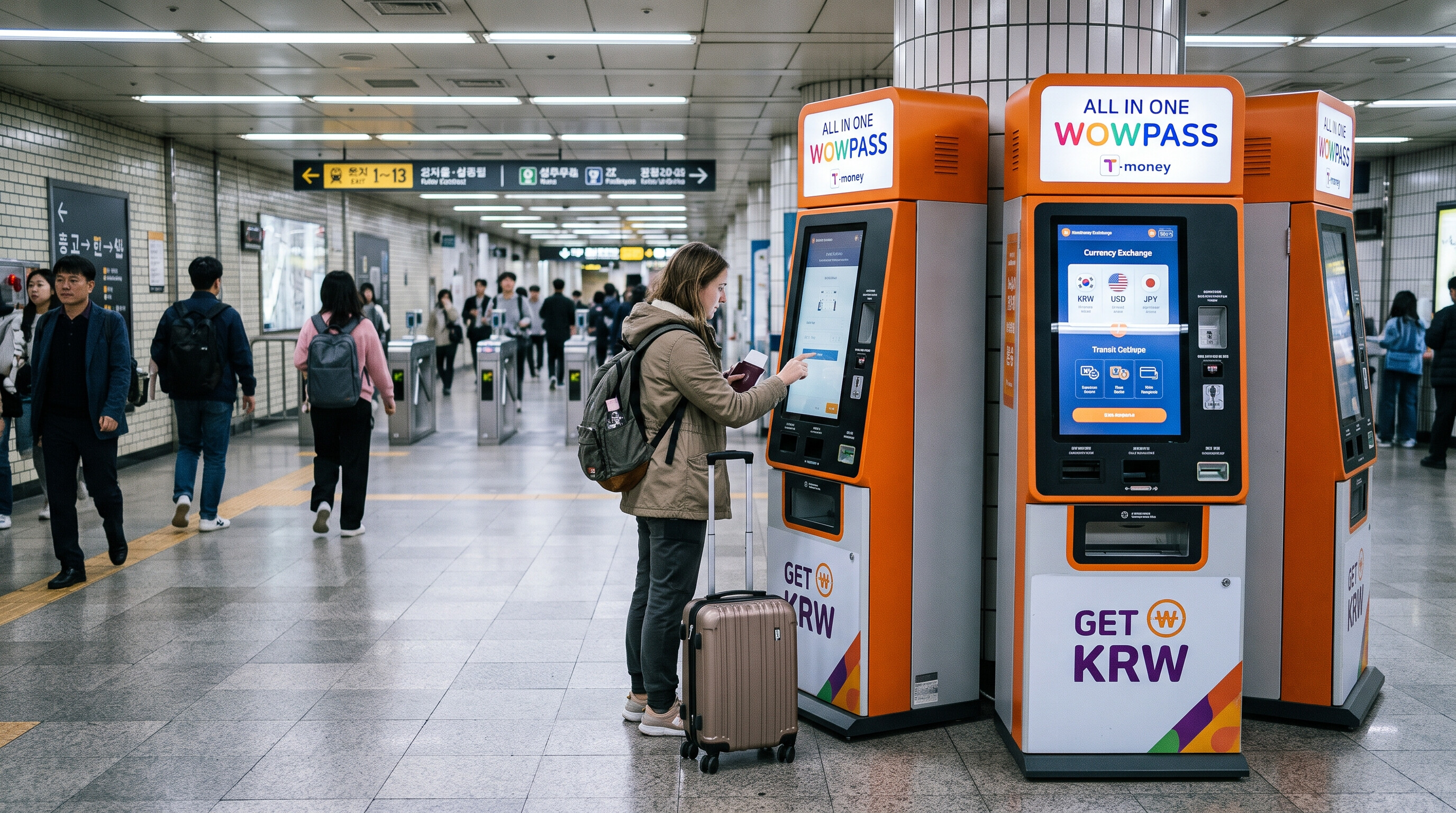
WOWPASS is a prepaid travel debit card tailored specifically for international visitors visiting South Korea. It is issued through eye-catching orange automated kiosks placed throughout Incheon Airport, Gimpo Airport, major subway stations (Seoul Station, Hongdae, Myeongdong, Gangnam), and flagship tourist hotels.
- Universal Merchant Acceptance: Unlike standard foreign credit cards that occasionally get flagged by local payment gateways, unmanned parking machines, or food order kiosks, WOWPASS is processed domestically as a Korean debit card. You can swipe or insert it at 99.9% of shops, cafes, Olive Young boutiques, street kiosks, and sit-down barbecue restaurants.
- Direct Currency Exchange & App Credit Card Top-Ups: You do not need to hunt down currency exchange booths in Myeongdong or withdraw Korean Won from airport ATMs with high fees. You can feed your home currency banknotes (16 currencies including USD, EUR, JPY, SGD, HKD, TWD, GBP, AUD, CAD) directly into a WOWPASS kiosk, OR top up your balance anytime inside the WOWPASS mobile app using an international credit/debit card, Apple Pay, or Google Pay.
- KRW Cash Withdrawal & Brand Cashback Perks: Need physical cash for traditional street food stalls at Gwangjang Market? You can withdraw crisp Korean Won bills from any orange WOWPASS kiosk (for a flat 1,000 KRW fee). Plus, the WOWPASS app offers instant cashback rewards at major tourist favorites like Olive Young, Daiso, Starbucks, and convenience stores.
- The Two-Balance Rule (Crucial to Know!):
Every WOWPASS card contains two distinct, isolated balances:- Prepaid Card Balance: Used for shopping, restaurants, convenience stores, and accommodation. Managed via the WOWPASS smartphone app and reloaded at kiosks.
- T-Money Transit Balance: Stored on an independent RFID chip embedded inside the card. Used for subways, city buses, and taxis nationwide.
Important Catch: Feeding foreign currency into a WOWPASS kiosk loads your retail shopping balance, not your transit balance! To ride the subway with WOWPASS, you must either:
- Withdraw a small amount of KRW cash from the kiosk and feed it into a regular subway ticket vending machine to charge the T-Money chip, or
- Use the WOWPASS mobile app’s built-in smartphone NFC top-up feature to transfer funds from your WOWPASS retail balance directly onto the T-Money chip.
Option 3: Traditional T-Money — The Tried-and-True Classic
The classic T-Money card remains the standard contactless transit card of South Korea. It is sold at virtually every convenience store (GS25, CU, 7-Eleven, Emart24) and subway station across the country.
- Physical Card Price: 3,000 to 5,000 KRW for standard designs, or up to 8,000–10,000 KRW for collectible K-pop editions (featuring BTS, NewJeans, or character collaborations like Line Friends and Sanrio).
- Where It Works: Everywhere in South Korea. T-Money works seamlessly on subways in Seoul, Busan, Daegu, and Daejeon, city buses on Jeju Island, airport express trains, and regional taxis.
- The Biggest Drawback in 2026: Cash-Only Reloads. Standard T-Money reload machines inside subway stations and convenience store cash registers only accept physical Korean Won banknotes. You cannot reload a traditional T-Money card using an international Visa, Mastercard, Apple Pay, or Google Wallet. You must first locate an ATM, withdraw KRW cash, and feed the paper bills into the machine.
4. Real-World Travel Scenarios: Which Card Fits Your Itinerary?
To make your choice crystal clear, let’s look at four standard tourist itineraries:
Scenario A: “The 4-Day Seoul City Sightseer”
- Itinerary: Exploring Myeongdong, Bukchon Hanok Village, Gyeongbokgung, Hongdae, Seongsu-dong, and Gangnam. No travel outside Seoul.
- Recommended Pick: Seoul Climate Card (3-Day or 5-Day Pass).
- Why: You will take 4 to 6 transit rides every day. An unlimited pass gives you total peace of mind and saves you 40% to 50% compared to pay-per-ride fares. For shopping and dining, simply use your existing international credit card (e.g., Chase Sapphire, Wise, or Revolut).
Scenario B: “The Cashless First-Timer Landing at Incheon”
- Itinerary: First time in South Korea, uncomfortable carrying bundles of physical cash, worried about foreign credit cards being declined at local eateries.
- Recommended Pick: WOWPASS All-in-One Card.
- Why: You step off your flight at Incheon Airport Terminal 1 or 2, walk up to the orange WOWPASS kiosk, insert crisp foreign bills, and receive an active card in under two minutes. You can board the AREX train immediately using the T-Money chip and swipe the card effortlessly at every cafe, convenience store, and street market stall during your stay.
Scenario C: “The Two-City Hopper (Seoul + Busan in 7 Days)”
- Itinerary: 3 days in Seoul, KTX high-speed train to Busan, 3 days exploring Haeundae, Gamcheon Culture Village, and Gwangalli Beach.
- Recommended Pick: Dual-Card Combo (Climate Card in Seoul + WOWPASS/T-Money in Busan).
- Why: The Climate Card only works inside Seoul, meaning it becomes useless the moment you reach Busan Station. By using a 3-Day Climate Card in Seoul and a WOWPASS or T-Money card for Busan metro, buses, and taxis, you maximize savings in the capital while maintaining complete mobility on the coast.
Scenario D: “The Day-Tripper (Nami Island, Suwon & DMZ)”
- Itinerary: Based in Seoul, but taking day excursions out to Suwon Hwaseong Fortress, Gapyeong (Nami Island / Garden of Morning Calm), or Incheon Chinatown.
- Recommended Pick: WOWPASS or Traditional T-Money.
- Why: The Climate Card triggers an error alarm at turnstiles located in Gyeonggi-do province (Suwon, Gapyeong, Incheon). T-Money and WOWPASS calculate distance surcharges automatically without turnstile interruptions.
5. The Pro Traveler Move: The Dual-Card Combo
If you want the ultimate, stress-free South Korean travel setup, adopt the Dual-Card Combo Strategy:
- Card 1: Seoul Climate Card (Short-Term Tourist Pass)
- Keep this card handy in your coat pocket or phone sleeve.
- Use it exclusively for all subway rides, city buses, and Ttareungi shared bicycles while moving within Seoul.
- Enjoy total freedom: take a two-stop bus ride instead of walking uphill, hop back to your hotel to drop off shopping bags, and ride late-night buses without worrying about fare meters.
- Card 2: WOWPASS All-in-One Card
- Keep this card in your wallet for everyday spending.
- Use it to pay for restaurants, street fashion shops, Daiso runs, and beauty hauls at Olive Young.
- Keep a 10,000–20,000 KRW balance on its built-in T-Money chip to handle transit exceptions: taking the AREX train from Incheon Airport on arrival, riding the Shinbundang Line into Gangnam, taking suburban day trips to Suwon, or exploring Busan and Jeju.
By pairing an unlimited city pass with a universal domestic prepaid card, you unlock the lowest transit costs and avoid international card processing friction.
Navigation Tip: Regardless of which card combination you carry, remember that Google Maps cannot provide walking or real-time transit directions in Korea. Be sure to pair your transit pass with our detailed guide on How to Use Naver Map in Korea (2026) for English subway transfer doors and live bus arrival countdowns.
6. Frequently Asked Questions (FAQ)
Q1. Can WOWPASS replace both T-Money and a regular credit card in Korea?
Yes. WOWPASS acts as a domestic prepaid debit card accepted at over 99% of Korean merchants, and its embedded T-Money RFID chip functions on all subways, buses, and taxis nationwide. However, keep in mind that the card operates with two independent balances: the WOWPASS retail balance (for shopping) and the T-Money transit balance (for transit). You must ensure both balances are topped up according to your needs.
Q2. Does the Seoul Climate Card work on subways or buses outside Seoul?
No. The Climate Card Tourist Pass is strictly valid within Seoul’s municipal boundaries. It does not cover suburban areas like Suwon, Incheon City, Gapyeong (Nami Island), or cities like Busan. It also excludes the privately operated Shinbundang Line and regional express commuter buses. Attempting to exit at an excluded station will trigger a gate alarm, requiring an attendant to collect fare differences in cash.
Q3. Can I reload a traditional T-Money card using an international credit card?
No. Standard T-Money cards can only be topped up using Korean Won cash banknotes at subway station vending machines or convenience store checkout counters. Foreign credit cards, Apple Pay, and Google Wallet are not supported at standard transit reload kiosks. Always keep several 1,000, 5,000, or 10,000 KRW paper banknotes in your wallet for emergency transit reloads.
Q4. What is the best travel card strategy for a 7-day trip to Seoul and Busan?
The most cost-effective and convenient strategy is the Dual-Card Hack: Use a Seoul Climate Card (e.g., a 3-Day or 5-Day pass) for unlimited subway and bus hops while sightseeing in Seoul, paired with a WOWPASS or standard T-Money card for your AREX airport train, retail dining/shopping, and all public transit once you arrive in Busan.
Q5. Can two or more travelers share a single transit card or WOWPASS?
No. Public transit systems in South Korea require one physical card per traveler. Each passenger must tap in at the entry turnstile and tap out at the exit gate individually. For retail purchases, however, anyone in your group can pay from a single WOWPASS debit card.
7. Final Summary: Your 10-Second Decision Guide
- Buy the Seoul Climate Card if: You are staying primarily in Seoul, want unlimited daily travel, and plan to ride subways and buses at least 3 times a day.
- Buy WOWPASS if: You want a completely cashless trip, wish to convert home currency into Korean Won instantly at airport kiosks, and want one card that pays for meals, shopping, and nationwide transit.
- Buy T-Money if: You already carry an international credit card with zero foreign transaction fees, plan to travel between several Korean cities, and only need a basic transit card.
- Best Strategy Overall: Combine a Seoul Climate Card for unlimited city hops with a WOWPASS for retail purchases and nationwide backup transit.